
Advice
Public Speaking Practice: 5-Min Power to Shine


From PTA Meetings to Boardroom Presentations
Enhancing your public speaking skills doesn’t have to be limited to formal settings—it can begin right in the comfort of your own home. Whether you’re gearing up for a school board meeting, a business presentation, or a heartfelt wedding toast, the key to confident speaking lies in consistent and purposeful practice that can easily fit into your busy schedule.
Essential Quick Practice Tips:
- Record yourself speaking for 5-10 minutes to pinpoint strengths and areas for improvement
- Commit to daily practice for just 5 minutes—consistency trumps perfection
- Incorporate the 4-1-4 breathing technique (inhale for 4 seconds, hold for 1 second, exhale for 4 seconds) to calm nerves
- Emphasize connection over perfection—your genuine voice holds more weight than flawless delivery
- Begin with bullet points instead of scripted lines to maintain a natural conversational flow
It’s a fact: 70% of employed Americans consider presentation skills crucial to their workplace success. However, many shy away from speaking opportunities due to fear. That flutter in your stomach before addressing the PTA? You’re not alone.
The encouraging news is that public speaking is a skill that can be honed, not just a talent one is born with. It improves with practice, much like mastering the art of parallel parking. Even seasoned speakers experience nerves; they’ve simply learned to channel that energy into connecting with their audience.
Every speaking opportunity—whether it’s a back-to-school event or a team meeting—becomes more manageable when you have practice techniques that seamlessly integrate into your everyday life.
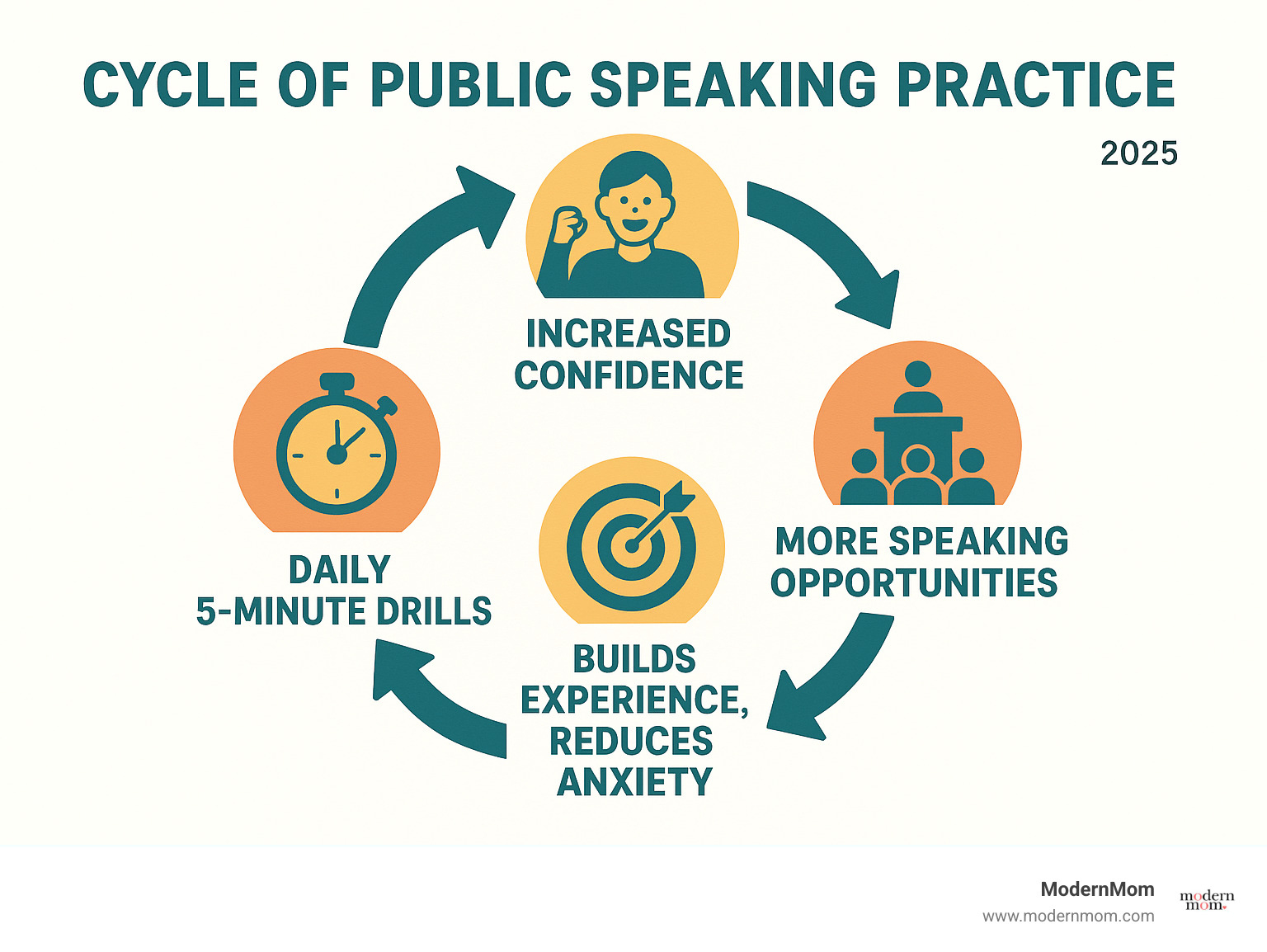
Why Practice is Your Superpower for Confidence
7.1% of U.S. adults have experienced social anxiety disorder in the past year, often manifesting as speaking anxiety. That knot in your stomach is normal, and it’s not something to eradicate—it’s energy you can harness for focus.
Consider public speaking practice as you would any other new skill. Just like you didn’t ace parallel parking on your first attempt, speaking confidently requires practice. Even innate talent necessitates practice to reach true excellence. While some individuals may feel more at ease initially, everyone can enhance their skills through practice. It’s about strengthening your confidence muscle, which improves with consistent use.
At ModernMom, we understand that nurturing self-confidence often commences with acknowledging your intrinsic value. You possess valuable insights to offer, whether you’re supporting your teenager through challenges or contributing to workplace discussions. Your voice holds significance, and practice enables you to communicate more effectively.
Know Your Goal and Your Audience
Before delving into what you’ll say, clarify why you’re saying it. Are you informing the PTA, persuading your team, or inspiring volunteers? Your objective shapes every other aspect of your speech.
Subsequently, consider your audience. Tailor the message towards them, not yourself. Parents seek insight into how policies impact their children; colleagues want to understand how your proposal benefits the team. By focusing on your audience, selecting the right words becomes more straightforward.
Once you grasp your purpose and audience, constructing your speech unfolds naturally. Commence with a concise main idea, reinforce it with key points, and bear in mind—you have roughly 30 seconds to captivate attention at the outset. Initiate with a relatable anecdote, a compelling statistic, or a probing question.
The Mindset Shift: Connection Over Perfection
Many of us become fixated on striving for flawlessness, yet perfection inhibits effective communication. Audiences resonate with authenticity, not artificial polish. Your personality, humor, and genuine concern are what engage listeners.
Transitioning from aiming for perfection to striving to connect alters everything. It’s acceptable to pause when collecting your thoughts or stumble over a word. What’s crucial is that your message emanates from an authentic place and resonates with real individuals.
Storytelling serves as your ace in the hole here. Instead of reciting facts, elucidate why the cause holds significance for you. Rather than listing policy alterations, expound on how they’ll streamline school pickup. Stories imprint in ways that bullet points cannot replicate.
Remember: the objective isn’t flawless execution. It’s about conveying something of value to individuals who need to hear it. This goal is more attainable and impactful.

The beauty of public speaking practice is that you don’t require a formal stage to witness genuine progress. Your living room serves as your practice arena, and your phone acts as your mentor. The key is to develop skills incrementally, free from the pressure of an audience. Think of it as mastering muffins before venturing into baking a wedding cake.
Start with Recording: Your Most Honest Mirror
Your smartphone proves to be a potent practice instrument. Recording yourself for 5-10 minutes provides insights that mirror practice cannot offer. Set up your phone, hit record, and deliver a segment of your presentation. This serves as your baseline.
Subsequently, take a moment for instant self-assessment. How did it feel? What came across as natural? Your initial reaction holds value.
Next, watch the recording with the sound off initially to concentrate on your body language. Is your posture assertive? Do your gestures reinforce your message? Proceed to listen to the audio without visual cues to isolate your vocal delivery. Is your voice clear? Do you speak too rapidly? Tally your “ums” and “ahs” without judgment—just acknowledgment.
Finally, watch and listen together. This process may seem unconventional, but it proves incredibly enlightening and aids in focusing your practice on areas that require attention.
Solo Drills for Impromptu and Prepared Speeches
The most effective speakers are adept at thinking on their feet, a skill beneficial in various scenarios from parent-teacher meetings to workplace discussions.
Impromptu speaking practice involves timing yourself for 1-2 minutes on random topics. Grab an object like a coffee mug or houseplant and elaborate on it for a minute. This simple exercise enhances your ability to swiftly organize thoughts and speak without reliance on a script.
Mirror exercises cultivate immediate body awareness. Practice delivering a brief speech in front of a mirror, concentrating on posture, purposeful gestures, and eye contact with yourself.
Reading aloud bolsters vocal strength and cadence. Opt for a poem, a passage from a book, or a renowned speech like Martin Luther King Jr.’s I Have a Dream. Focus on rhythm and intonation to acclimate to the flow of impactful speaking.
Master Your Message: From Jargon to Simple & Clear
The most effective messages are the clearest ones. It might be tempting to resort to technical jargon when anxious, but simplicity and clarity consistently outshine complexity and ambiguity.
Try explaining your core idea to someone outside your field entirely—such as your teenager or a friend. If they grasp it, you’re on the right track. This exercise compels you to strip away intricacy, akin to when you’re elucidating financial concepts to children.
Work from an outline, not a script. Allocate roughly one hour of preparation for every five minutes of speaking, utilizing that time to organize key points into bullet form. This approach ensures a conversational delivery.
Create a confidence card—a single index card featuring trigger phrases. It serves as a safety net, not a crutch. The aim is to be well-versed in your material to facilitate a dialogue, not a recitation.
Fine-Tuning Your Delivery: The Art of Being Heard
A coherent message is just half the battle—delivery determines whether your audience truly comprehends your message. Public speaking practice isn’t solely about what you say; it’s about mastering the verbal and nonverbal components that breathe life into your words. The encouraging news is that these skills can be cultivated at home within a few minutes daily.
Command the Room with Your Voice
Your voice serves a dual purpose—it highlights key points, fosters connection, and sustains audience engagement.
Vocal variation stands as your ally against monotonous delivery. Experiment by emphasizing a different word in a sentence each time you say it. “I never said she stole my money” transforms into seven distinct messages based on the emphasized word.
Precise pronunciation ensures impact. Tongue twisters remarkably enhance crisp diction. Dedicate two minutes daily to classics like “Red leather, yellow leather.” You’ll find this list of popular tongue twisters beneficial.
Nervousness often leads to speaking too rapidly. During public speaking practice, try maintaining a pace at 50% of your natural speed. It may feel sluggish, but it fosters control. Gradually transition back to a comfortable pace where every word resonates.
Breathing exercises yield remarkable results. The 4-1-4 breathing technique works wonders: inhale for 4 seconds, hold for 1 second, then exhale for 4. Implement this routine for a few minutes before speaking to pacify your nervous system.
Projecting without shouting is an art form. Practice speaking as if you’re conversing with someone across a spacious room—firm and articulate, yet still conversational.
Let Your Body Language Do the Talking
Your body communicates before you utter a single word. Your stance, movements, and gestures can either reinforce your message or detract from it.
Posture serves as the cornerstone. Stand tall with shoulders squared and feet firmly planted. Exceptional posture not only exudes confidence but enhances your own sense of it as well.
Eye contact fosters connection. Direct your gaze at the camera lens during recordings or select focal points around the room. Strive for 2-3 seconds of eye contact with each “individual” to cultivate the habit of engaging everyone.
Purposeful gestures should complement your words. Let your hands move naturally, but avoid fidgeting when nervous. If uncertain, allow your hands to rest by your sides.
Review recordings to identify nervous tics like swaying or touching your face. Once pinpointed, consciously substitute them with deliberate movements.
Utilizing your space strategically sustains audience engagement. Practice movement during transitions or stepping forward to underscore a pivotal point, as discussed in “Taking Meetings from Dull and Dreadful to Energetic and Effective.”
The Power of the Pause: Taming Filler Words
Filler words such as “um” and “uh” tend to creep in when nervous. The solution isn’t to eradicate them entirely but to replace them with something more impactful: deliberate silence.
Substituting filler words with silence may feel awkward initially, but a pause affords you time to reflect while allowing your audience to absorb your message. A well-placed pause can be more resonant than any word.
Practice incorporating intentional pauses by marking them in your notes. Utilize them for emphasis or to allow complex information to resonate.
Conveying thoughts in shorter sentences organically diminishes the need for fillers. When you’re not attempting to cram multiple ideas into one sentence, you’re less likely to stumble.
Seamless transitions between concepts also aid in eradicating hesitancy. Practice linking your main points with clear bridges like “The second benefit is…” or “This leads us to…”
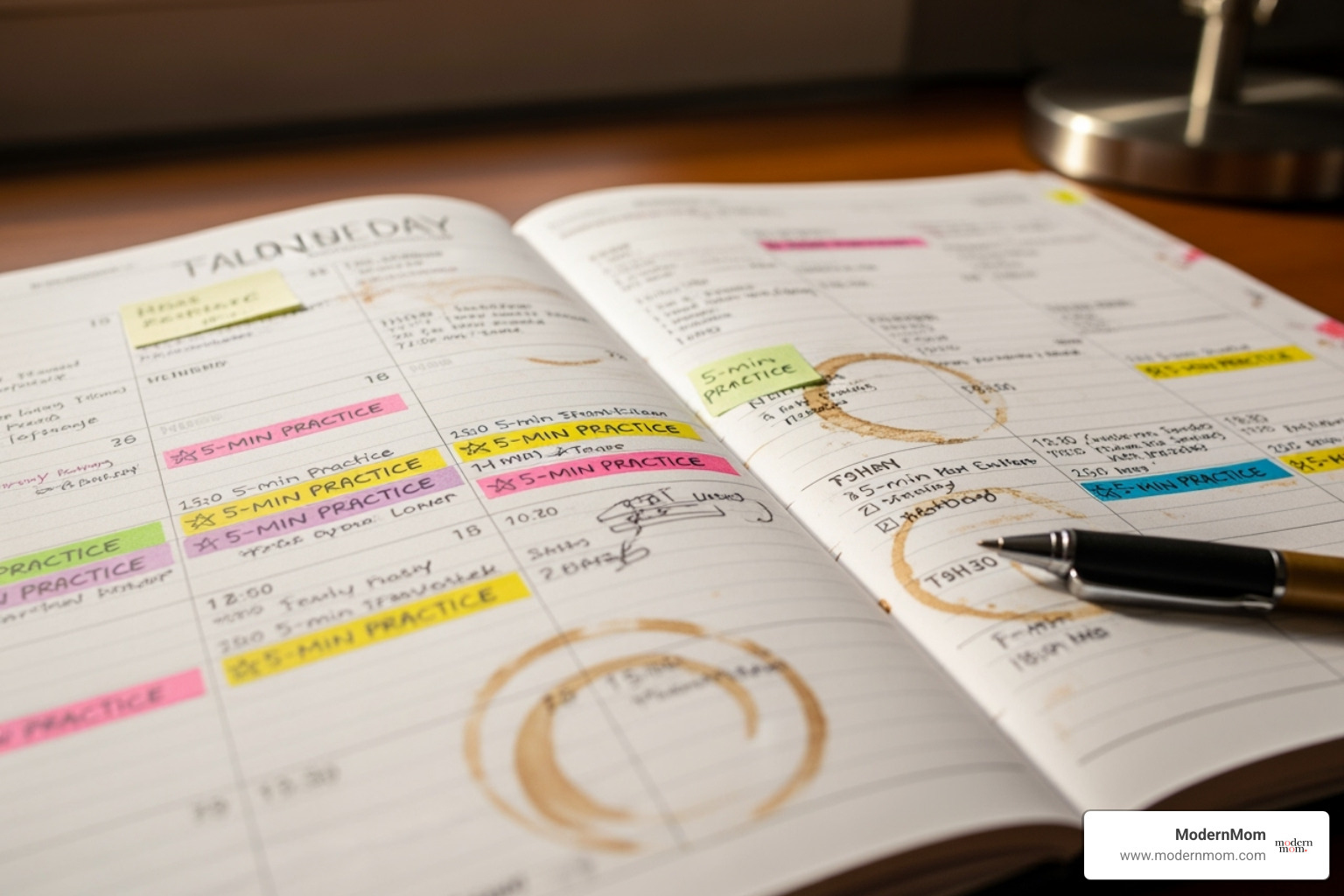
Creating a Routine That Fits Your Busy Life













5 Amazing Benefits Of Stacking Toy

Nordic founders are taking bigger swings, and it’s paying off

5 Apps To Speed Up Your Google TV Device

Trump threatens ABC News for reporter’s questions on his family business in Saudi Arabia, Khashoggi’s murder and Epstein files

The Best Sunglasses for Travel + Must Have Accessories » Local Adventurer » Travel Adventures in Las Vegas + World Wide

This Silent Habit Might Be Sabotaging Your Career

The Four Types of Happiness: Which One Are You Living In?

Halloween Events in London 2025

Join the peaceful demonstrations for democracy

Cute and Thankful Sayings for the People You Love

Croatia to reintroduce compulsory military draft as regional tensions soar

Singapore Airlines CEO set to join board of Air India, BA News, BA

Supernatural Season 16 Revival News, Cast, Plot and Release Date

How Your Contact Center Can Become A Customer Engagement Center

Bangladeshi police agents accused of selling citizens’ personal information on Telegram

Google Pixel 9 Pro vs Samsung Galaxy S25 Ultra: Camera Comparison Review

The Criterion Collection announces November 2024 releases, Seven Samurai 4K and more

Fallout Season 2 Potential Release Date, Cast, Plot and News

15 of the Best Trike & Tricycles Mums Recommend

17 Signs You Travel A Lot
-
 Breaking News2 years ago
Croatia to reintroduce compulsory military draft as regional tensions soar
-
 Destination1 year ago
Singapore Airlines CEO set to join board of Air India, BA News, BA
-
 Gadgets1 year ago
Supernatural Season 16 Revival News, Cast, Plot and Release Date
-
 Productivity2 years ago
How Your Contact Center Can Become A Customer Engagement Center
-
 Tech News2 years ago
Bangladeshi police agents accused of selling citizens’ personal information on Telegram
-
 Gadgets10 months ago
Google Pixel 9 Pro vs Samsung Galaxy S25 Ultra: Camera Comparison Review
-
 Gaming2 years ago
The Criterion Collection announces November 2024 releases, Seven Samurai 4K and more
-
 Gadgets10 months ago
Fallout Season 2 Potential Release Date, Cast, Plot and News